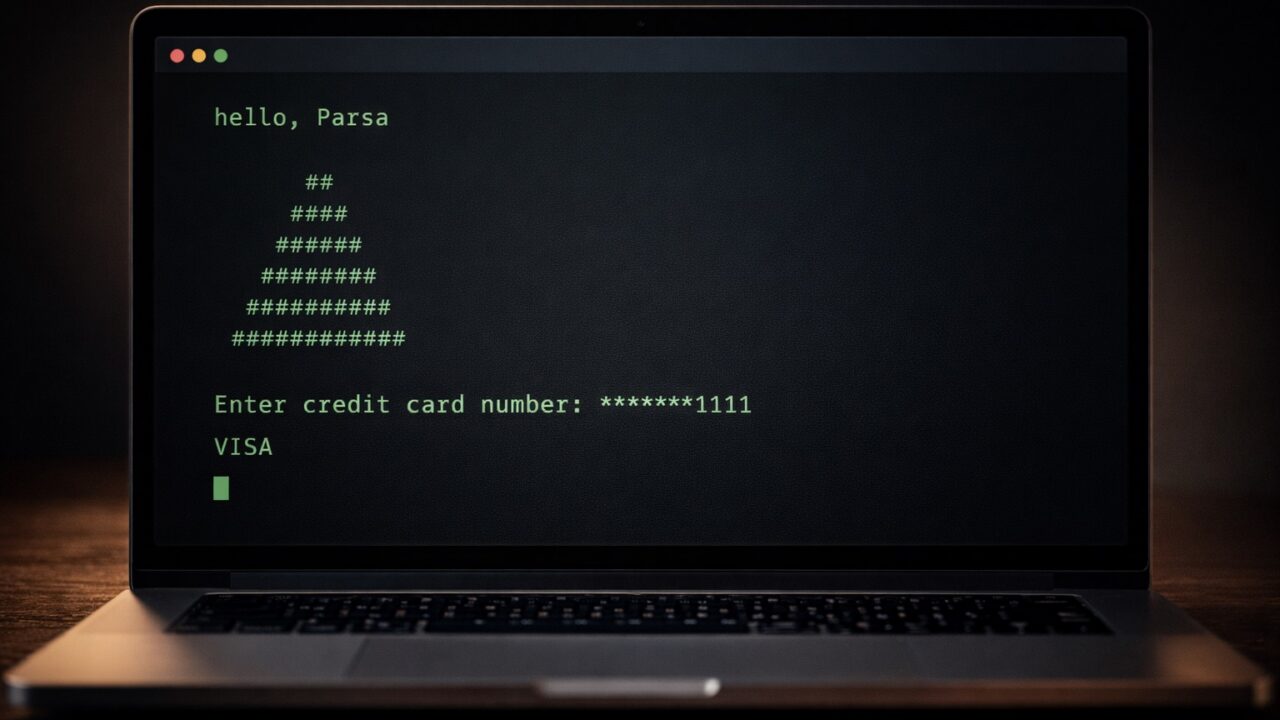
Week 1 of CS50x is where things get real. You go from watching lectures about how computers think to actually writing C — a language that does not hold your hand, does not guess what you meant, and will absolutely refuse to compile if you forget a semicolon. The three problem sets for this week are Hello, Mario, and Credit, and together they cover a solid range of what C programming is actually about. Hello is the warm-up: prompt the user for their name, store it in a string, print a greeting. Simple on the surface, but it introduces the CS50 library, the get_string function, and the idea that in C you are always thinking about types and memory, even when you are just saying hello.
Mario steps things up quite a bit. The task is to print a double pyramid of hashes — the kind you see in the classic Super Mario Bros game — using nothing but loops and printf. The tricky part is the spacing. Getting the right number of spaces on the left, then the hashes, then the two-space gap in the middle, then the hashes again on the right, all scaling correctly with the height the user picks — that takes a bit of working out. The approach here uses three nested loops per row: one to handle the leading spaces, one for the left column of hashes, and one for the right. Input validation is handled with a do-while loop that keeps prompting until the user gives a number between 1 and 8, which is a clean and efficient pattern. Credit is the most involved of the three. It takes a credit card number as a long, checks the digit count, runs Luhn’s algorithm to verify the checksum, and then identifies whether the card is a Visa, Mastercard, or American Express based on the leading digits. The code is broken into four separate functions — digit counting, digit extraction, Luhn’s algorithm, and card type identification — which keeps things readable and makes each piece easy to test independently.
What Week 1 really teaches you is how to think in C. You cannot be vague. Every variable has a type, every loop has a condition, every function has a return type. Writing the credit card validator was a good lesson in that — working with a long across multiple functions, extracting individual digits using powers of ten, and making sure the Luhn sum logic handles both single and double-digit results correctly. These are the kinds of problems that build real programming instincts. By the end of the week the basics of C feel much less intimidating, and the advantage of starting with a lower-level language like this is that everything you learn later — Python, Flask, SQL — feels more intuitive because you understand what is happening underneath.
The full code for this week is up on GitHub — you can browse the Week 1 folder directly to see all three programs, or explore the entire CS50x repository to follow the course week by week as it progresses.